
On the Power of Words

Updated: Aug 13
You surely know, from your own experiences, that the words you use have a significant power in your life and in the lives of those around you; that they have had and will continue to have an effect, and that your past experiences have shown you your ability to influence your own emotional state and that of the people you've had a conversation with. This may seem subtle at first, but with the shaping of time and its cycles it starts to solidify through the way you and I construct our identity and our relationship with everything around us.
Hence the question: how do we manage to sometimes lose sight of something that affects every aspect of our lives?
That said, this writing aims to refresh your relationship with words in every sense, as well as recalibrate what you've come to accept; both in what we tell ourselves and what others tell us. I'm also excited to share with you a concise compilation of concepts that have expanded my perspective on language and its power in the human psyche throughout the times.
Words are so present in our lives that it's easy to undervalue their magic, and yet, even when we pay attention to them, we also tend to unconsciously go with the modern cultural/social distortion we've attributed to every term. For example, when reading "magic", an infinitude of images, concepts, pop-culture references, conceptions and judgments tend to appear in front of your attention, thus giving it an association that has been forming since you were old enough to reason. And it's this matter of the 'external influence' where I'd like to begin.
What are three words that provoke a negative/defensive reaction in you, and why? & why are there words that make you cringe? What power do they have over you, and who has influenced you? (this blog includes some questions, suggested activities, and interesting facts intended to spark your curiosity and reflection, so if you don’t have your notebook ((or a sheet of paper)) handy, I invite you to pause here and grab it.)
Words, as we form our character, coalesce & solidify into beliefs and agreements—tools that help us understand and organize ourselves in relation to others, channels that offer opportunities for inspiration and for delving deeper into what resonates within us. And while they tend to open us up to new possibilities, they can also drown out the whisper of our inner wisdom. In other words, everything we accept and validate through repetition either expands us or limits us.
That is why I find it crucial, from time to time, to take a few steps back to re-examine -and redefine- our relationship with the words we use and the habitual thoughts that arise in our daily lives.
I have observed, in certain relationships and social circles, a casualness (and sometimes immaturity) regarding speech—manifesting in jokes, gossip, memes, and even complaints. These forms of expression can turn into unconscious wounds that keep us within the confines of conformity, nudging us to maintain attitudes and behaviors rooted in fears, insecurities, and cultural backgrounds that have become diluted over time.
What words do I repeat to myself, and what effect do they have on me?
Review: What agreements -whether beliefs, automatic thoughts, guidelines, judgments, and so on- have both expanded and limited your ability to grow in your current stage of life? Which of the things you accept or believe have propelled your development, and which have held you back?
Here is an inventory activity I have found useful: Draw a line down the middle of a sheet of paper. On one side, list the agreements that have expanded your possibilities for self-expression; on the other, list the judgments that you feel have limited the way you relate to yourself and the world.
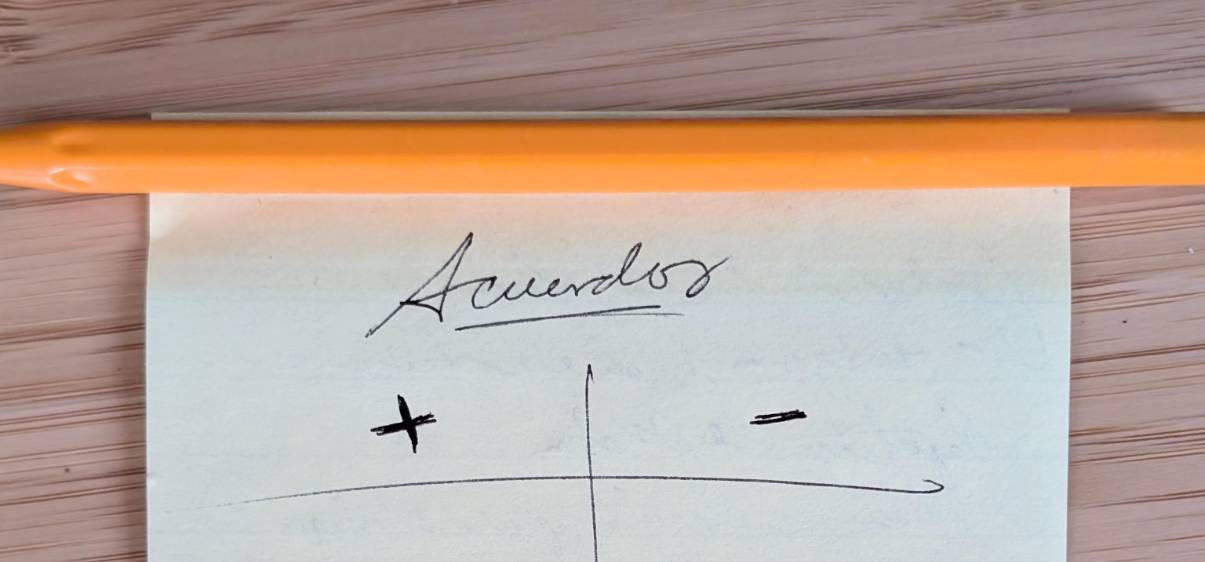
You will find that by putting them down on paper, you can view them from a slightly more detached perspective, making it easier to shed those mental agreements that have been detrimental to your well-being. At the same time, you'll be able to reinforce those agreements that have helped you; these will help anchor you in the personal truths you have put to the test—truths that have empowered you to remain centered in your own proces.
A brief list of words and concepts
“Abracadabra”
This magic word is recorded as far back as the 2nd century AD in the “Liber Medicinalis” by Serenus Sammonicus, who recommended its use as an amulet for those wishing to cure a fever. Later, it acquired the more general meaning of “I create as I speak.”
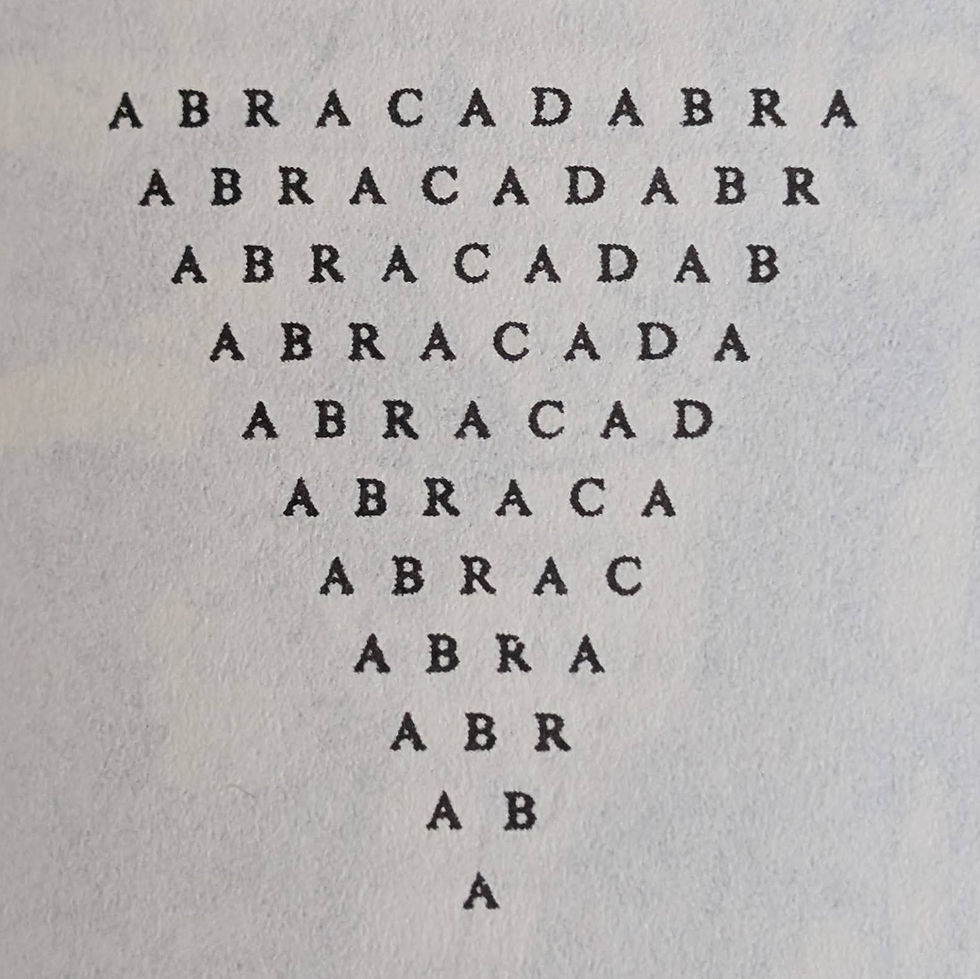
Here is the entry from Juan E.C.’s “Dictionary of Symbols”: “Many words and phrases associated with rituals, talismans, and pentacles possess a symbolic meaning—whether in the words themselves or in the manner of their use—that is expressed phonetically or, more frequently, graphically. This word was frequently used as a magic formula during the Middle Ages. It derives from the Hebrew phrase abreq ad hâbra, meaning ‘hurl your thunderbolt, even unto death.’ It was generally inscribed within an inverted triangle or arranged to form a triangle.”
Mantras
The word "mantra" comes from Sanskrit and is formed by combining “man” (mind) and the suffix “-tra” (liberation, protection, or instrument); thus, its meaning is "mental instrument" or "means to liberate the mind." -etimologias.dechile.net
Since there is so much to explore here, I leave you with an excerpt from the book “Meditation as Medicine” by Dr. Dharma Singh Khalsa and Cameron Stauth regarding the vibratory effects of mantra-chanting and some of their significant physical impacts:
They improve immune function via the hypothalamic-pituitary axis.
They enhance balance between the brain's hemispheres.
They help quiet the internal dialogue.
They boost proper DNA replication, thereby contributing to the maintenance of genetic integrity.
The Properties of Frequency and Vibration
Continuing the references from “Meditation as Medicine”, here is a paragraph that masterfully describes this point:
"In the human body, vibratory waves capable of generating sound exert their most pronounced effect on our two most sensitive systems: the neurological and the endocrine. The vibrations we produce ourselves when speaking have the most direct and powerful effects; they cause intense vibration in the brain, as well as in the pituitary gland and the hypothalamus, which are located near the roof of the mouth. When this occurs, extraordinary physiological processes are triggered. The vibration of the pituitary gland -the master gland of the endocrine system- significantly boosts its activity, much like massaging a lymph node stimulates its function. As it vibrates, the pituitary increases its secretion output, which in turn optimizes the functioning of the entire endocrine system."
“Spell-ing": dissecting a word + casting a spell
It fascinates me that the word "spell" is used both to refer to an act of magical transformation and to the act of mentioning each of the letters of a word. I have nothing more to say here, so I’m attaching an image I saw in a friend’s Stories and a quote I found on an oracle card co-created by Ina Gold, a talented artist from Monterrey (I’ll update this section with the actual photo later!).

“Speak of the blessings in your life, and you will attract more of them. Every word you utter is an affirmation.”
What other concepts and words come to mind? Send us a message (or leave a comment on this blog post) sharing what has resonated with you throughout your studies!
What We Read and Its Impact on Our Lives
Which books have changed the way you communicate? What beliefs or agreements have you adopted from them, and how do you feel that they bring direction and clarity to your life?
While writing this, Don Miguel Ruiz’s books on the Fourth and Fifth Agreements came to mind—specifically regarding how words (and our relationship with them) create a sort of "smoking mirror" (a perceptual distortion) between us and reality itself. Speaking of which, another book that has expanded how I relate to myself and the world is the aforementioned Dictionary of Symbols by Juan Eduardo Cirlot. It delves deep into concepts of language and culture through a synthesis that is impressively interconnected with the world's various cultures and bodies of knowledge. What fascinates me about this book is that it traces the origins and backstories of so many elements we engage with—elements that help us make sense of our collective human experience.
Finally, I’d like to come back to “Meditation as Medicine” by Dr. Dharma and Cameron S., as well as Joe Dispenza’s “Becoming Supernatural”. These books have transformed my relationship with breathing, the impact of the words I think and speak, and the coherence between mind and heart achieved by combining these practices.
I hope this plants seeds of curiosity and sparks future conversations about what you’ve learned and applied through these books, or others you’ve discovered yourself. 🙂💝
A Conclusion, for now
Everything I’ve shared here might sound like common sense, but I feel that we all benefit from the occasional reminder, especially in these times of constant exposure to the noise of the digital world. Just as we are mindful of what we say, we also have a great responsibility to be mindful of what we take in from the internet. The use of our language is one of the great tools we have for connecting with and participating in the world around us and the one that dwells within us; it is, therefore, the ability with the greatest power to transform the ways we relate to everything, in every sense.
Given all this, the idea of using our words to spread gossip, mock others, or belittle anyone seems absurd. My intention, then, is to anchor us in the truth that everything ultimately acts as a mirror; it becomes clear that if we support those around us, they support us in return. And although a part of us might cynically seek to find flaws in this—tempted to reject it because of the lack of immediacy in the external results—the real matter here lives in something far more subtle: the internal effect and in the ability of letting go of expectations regarding how others respond. The true consequence arises from the energy we generate when we formulate our expression. In other words, the love or hate we express originates within our own center before being projected outward. That is the real effect that precedes the immediate act of speaking.
Like any muscle, synapse, or habit, the words we use stem from past experiences; only through repetition -while remaining centered in this awareness- can we create a change that transforms our daily lives. ¡salúd!


Comments